
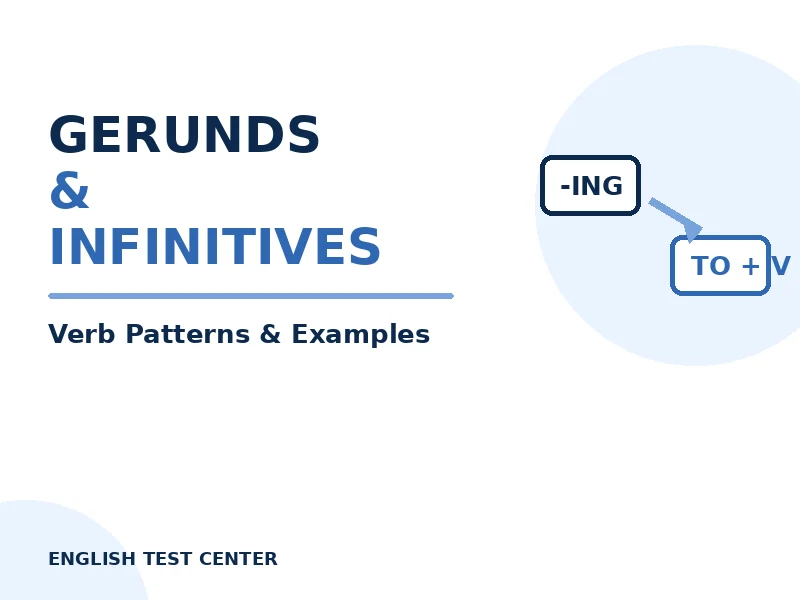
A gerund is the -ing form of a verb used in a noun-like way, while an infinitive is commonly formed with to + base verb. Some English verbs are followed by gerunds, others by infinitives, and some can take both forms. Learning these patterns improves both accuracy and natural fluency.
What Is a Gerund?
- A gerund has the -ing form: reading, swimming, studying.
- It can function as the subject of a sentence: Reading helps me relax.
- It can follow certain verbs: enjoy reading, avoid driving, finish working.
- It commonly follows prepositions: interested in learning, good at speaking.
What Is an Infinitive?
- The to-infinitive uses to + base verb: to read, to study, to travel.
- It commonly follows verbs such as want, decide, hope, plan, promise and need.
- It can express purpose: I went to the shop to buy milk.
- Some adjectives are followed by infinitives: happy to help, ready to leave.
Common Gerund Verbs
- enjoy, avoid, consider, finish, mind, suggest, keep, practise, admit, deny.
- Example: She suggested taking the train.
- Example: He avoids eating late at night.
Common Infinitive Verbs
- want, decide, hope, plan, agree, promise, refuse, learn, expect, manage.
- Example: We decided to leave early.
- Example: She managed to solve the problem.
Verbs That Change Meaning
- Remember doing refers to a memory of a past action; remember to do means not forgetting a necessary action.
- Stop doing means end an activity; stop to do means pause one activity in order to do another.
- Try doing means experiment with a method; try to do means make an effort.
- Regret doing looks back on a past action; regret to inform is a formal expression used before giving bad news.
Common Mistakes
- Incorrect: I enjoy to read. Correct: I enjoy reading.
- Incorrect: She decided going home. Correct: She decided to go home.
- Incorrect: He is interested to learn English. Correct: He is interested in learning English.
Gerunds Quick Review
Before you move to the practice section, review the key patterns above and pay special attention to the examples and common mistakes. Grammar becomes easier when you compare correct forms with typical errors and then use the structure in complete sentences.
Practice Worksheet
Complete each sentence with the best form. Try to answer without looking back at the rules.
- I enjoy ___ (read) before bed.
- They decided ___ (move) to another city.
- She is good at ___ (solve) problems.
- We hope ___ (see) you soon.
- He avoided ___ (answer) the question.
- Remember ___ (lock) the door tonight.
- I remember ___ (visit) that museum as a child.
- She suggested ___ (take) a taxi.
- They managed ___ (finish) on time.
- He stopped ___ (smoke) last year.
Show Worksheet Answers
- reading
- to move
- solving
- to see
- answering
- to lock
- visiting
- taking
- to finish
- smoking
Mini Grammar Quiz
1. After enjoy, use:
A) to + verb
B) verb-ing
C) bare infinitive only
2. After decide, use:
A) verb-ing
B) to + verb
C) past participle
3. ‘Stop smoking’ means:
A) pause in order to smoke
B) end the habit of smoking
C) try smoking
4. After a preposition, a verb normally takes:
A) -ing
B) to + infinitive
C) past simple
5. Choose the correct sentence.
A) She suggested to go.
B) She suggested going.
C) She suggested go.
Show Quiz Answers
- B
- B
- B
- A
- B
Frequently Asked Questions
What is a gerund?
A gerund is the -ing form of a verb used in a noun-like role, such as Swimming is fun.
What is an infinitive?
An infinitive is commonly to + base verb, such as to study or to leave.
Can a verb take both forms?
Yes. Some verbs can be followed by either form, sometimes with little change and sometimes with a significant change in meaning.
What comes after a preposition?
When a verb follows a preposition, it normally takes the -ing form.
Continue Practicing English Grammar
Use the related English Test Center resources below to reinforce this topic and practise grammar in context.
- Grammar Worksheets
- B1 Grammar Exercises
- Browse All English Grammar Worksheets
- English Grammar Exercises A1–C2
Keep practising with English Test Center to improve grammar accuracy, confidence, and exam performance in everyday, academic, IELTS, TOEFL, and YDS English.