
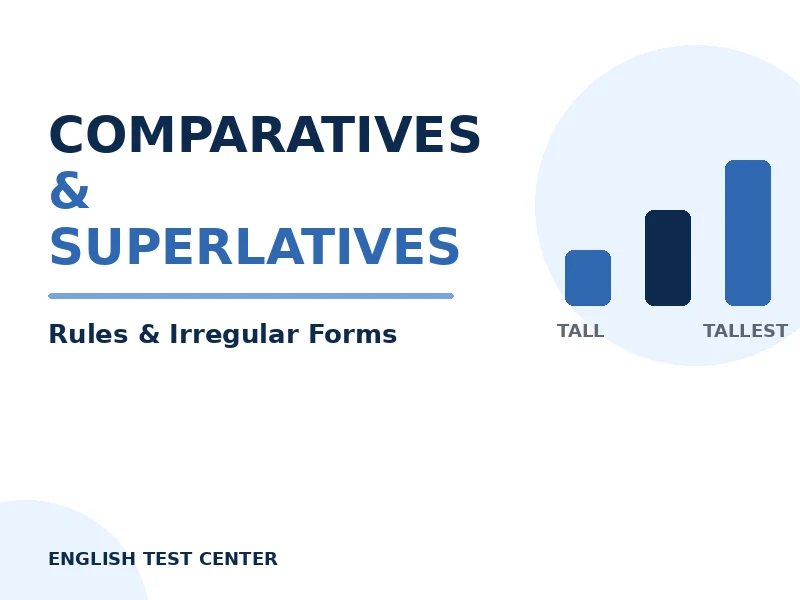
Comparative adjectives compare two people or things, while superlative adjectives compare one member with a whole group. English forms these structures in different ways depending on the adjective. Short adjectives often use -er and -est, while longer adjectives usually use more and most.
Short Adjectives
- Most one-syllable adjectives add -er and -est: tall → taller → tallest.
- Adjectives ending in -e add -r and -st: nice → nicer → nicest.
- Short consonant-vowel-consonant adjectives often double the last consonant: big → bigger → biggest.
- Adjectives ending consonant + y change y to i: happy → happier → happiest.
Long Adjectives
- Many adjectives of two or more syllables use more and most.
- interesting → more interesting → most interesting.
- Do not combine both patterns: more easier and most fastest are incorrect.
Irregular Forms
- good → better → best.
- bad → worse → worst.
- far → farther/further → farthest/furthest.
- little (amount) → less → least.
Using Than and The
- Comparatives are commonly followed by than: This test is easier than the last one.
- Superlatives normally use the: She is the tallest student in the class.
- Use in for places/groups and of for periods or sets when natural: the best in the class; the coldest day of the year.
Equality and Less
- As + adjective + as expresses equality: This book is as useful as that one.
- Not as … as expresses inequality.
- Less + adjective can make a weaker comparison: less expensive.
Common Mistakes
- Incorrect: more faster. Correct: faster.
- Incorrect: the most easiest. Correct: the easiest.
- Incorrect: She is tallest in class. Correct: She is the tallest in the class.
Comparatives Quick Review
Before you move to the practice section, review the key patterns above and pay special attention to the examples and common mistakes. Grammar becomes easier when you compare correct forms with typical errors and then use the structure in complete sentences.
Practice Worksheet
Complete each sentence with the best form. Try to answer without looking back at the rules.
- This car is ___ (fast) than mine.
- She is the ___ (careful) person in the team.
- Today is ___ (hot) than yesterday.
- This is the ___ (good) restaurant in town.
- My bag is ___ (heavy) than yours.
- Math is ___ (difficult) for me than English.
- That was the ___ (bad) day of the week.
- This phone is as ___ (expensive) as that one.
- The blue route is ___ (long) than the red route.
- It is the ___ (interesting) chapter in the book.
Show Worksheet Answers
- faster
- most careful
- hotter
- best
- heavier
- more difficult
- worst
- expensive
- longer
- most interesting
Mini Grammar Quiz
1. Comparative of ‘good’:
A) gooder
B) better
C) more good
2. Superlative of ‘bad’:
A) baddest
B) worse
C) worst
3. Choose the correct sentence.
A) This is more easier.
B) This is easier.
C) This is easiest than that.
4. Superlatives usually take:
A) a
B) the
C) no article always
5. Comparative of ‘happy’:
A) happier
B) more happy always
C) happyer
Show Quiz Answers
- B
- C
- B
- B
- A
Frequently Asked Questions
When do we use comparatives?
Use comparatives mainly to compare two people, things, places or situations.
When do we use superlatives?
Use superlatives when one member is compared with all others in a group.
Can we say more easier?
No. Use either easier or, with adjectives that require it, more + adjective.
What are the main irregular forms?
Common irregular patterns include good–better–best and bad–worse–worst.
Continue Practicing English Grammar
Use the related English Test Center resources below to reinforce this topic and practise grammar in context.
- Grammar Worksheets
- B1 Grammar Exercises
- Browse All English Grammar Worksheets
- English Grammar Exercises A1–C2
Keep practising with English Test Center to improve grammar accuracy, confidence, and exam performance in everyday, academic, IELTS, TOEFL, and YDS English.